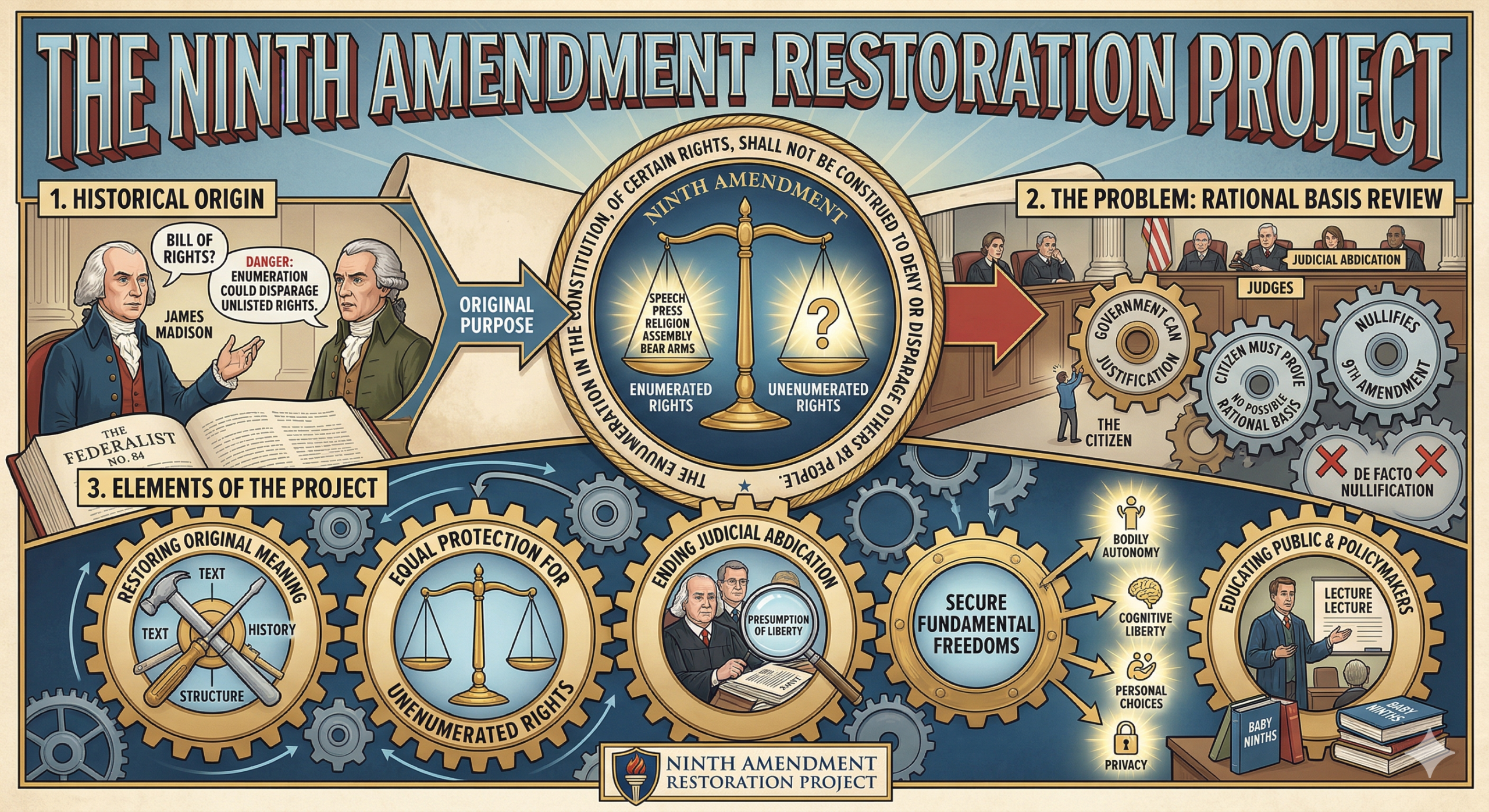
The Ninth Amendment to the United States Constitution represents one of the most profound and conceptually complex declarations of human liberty within the American legal tradition. It states: “The enumeration in the Constitution, of certain rights, shall not be construed to deny or disparage others retained by the people”. This single sentence, comprising only twenty-one words, serves as the constitutional bridge between the explicit, written protections of the Bill of Rights and the vast, unwritten reservoir of inherent rights that the Founders believed were possessed by individuals prior to the formation of any political society. For much of American history, the Ninth Amendment was regarded as a “dormant” provision, a historical curiosity that appeared more as a rule of construction than a source of enforceable rights. However, the mid-twentieth century witnessed a dramatic judicial reawakening of the clause, as it became central to the development of the constitutional right to privacy and a focal point for modern debates concerning originalism, judicial activism, and the nature of natural law.
Philosophical Underpinnings and the Concept of Natural Rights
The Ninth Amendment cannot be understood in isolation from the Enlightenment-era philosophy that guided the American Founding. The Framers operated within a Lockean framework of natural law, which posited that individuals in a “state of nature” possess absolute and inherent rights—liberties that are not granted by the state but are inherent to human existence. When individuals enter into a social compact to form a government, they do not surrender all their rights; rather, they cede only a limited portion of their freedom to a central authority in exchange for the protection of their remaining, retained liberties. This philosophy is explicitly articulated in the Declaration of Independence, which identifies unalienable rights to life, liberty, and the pursuit of happiness as the primary reason for the existence of government.
The Ninth Amendment serves as a formal acknowledgment within the Constitution that this philosophical “residuum” of rights exists. It acts as a textual placeholder for the infinite variety of human activities that fall outside the government’s legitimate sphere of regulation but were too numerous or self-evident to be listed individually in 1789. This concept of “retained rights” suggests that the Constitution is not a grant of rights to the people, but a grant of limited powers to the government, with the people remaining the ultimate reservoir of all other authority.
The Federalist-Antifederalist Debate and the Danger of Enumeration
The inclusion of the Ninth Amendment was a direct response to a strategic dilemma faced by the Federalists during the ratification debates of 1787 and 1788. Initially, the proposed Constitution contained no bill of rights, a choice that the Anti-Federalists used as a primary point of opposition. George Mason, one of the most prominent dissenters at the Constitutional Convention, famously refused to sign the document, noting that “there is no Declaration of Rights”.
The Federalist Objection
Federalists such as Alexander Hamilton and James Wilson argued that a formal listing of rights was not only unnecessary but potentially dangerous. Their objection was rooted in the structure of the proposed national government as one of strictly enumerated powers. Hamilton, writing in Federalist No. 84, argued that because the government only had the powers explicitly granted to it in Article I, Section 8, it lacked any authority to infringe upon the rights of the people in the first place. He questioned why it would be necessary to state that the “liberty of the press shall not be restrained” when the government was given no power to impose such restrictions.
Furthermore, Federalists feared the application of the legal maxim expressio unius est exclusio alterius—the expression of one thing implies the exclusion of others. They contended that by enumerating specific exceptions to federal power, the Constitution might be interpreted to imply that any rights not mentioned were surrendered to the General Government and were therefore insecure. This “negative implication” could provide a “colorable pretext” for the government to claim powers beyond those enumerated, effectively turning a shield for liberty into a sword for tyranny.
The Role of State Ratification Conventions
Despite these arguments, the Anti-Federalist demand for a bill of rights resonated with the public. Several states, including Virginia and New York, ratified the Constitution only on the understanding that a series of amendments would be added immediately. Approximately eight state conventions submitted proposed amendments, many of which focused on ensuring that the enumeration of certain rights would not be used to justify the infringement of others.
| State Convention | Core Concern Regarding Rights | Proposed Solution Pattern |
| Virginia | Fear of constructive enlargement of federal power via negative implication. | Explicitly stating that unlisted rights are retained and that powers are not extended. |
| New York | Concern that federal authority would swallow state-level protections. | Reaffirming the limited nature of delegated powers. |
| Massachusetts | Necessity of a formal declaration to protect individual conscience. | Listing specific rights alongside a general reservation of liberty. |
James Madison and the Evolution of the Ninth Amendment
James Madison, initially a skeptic of a bill of rights, became its primary champion in the First Congress to fulfill the political promises made during ratification. In drafting what would become the Ninth Amendment, Madison sought to neutralize the Federalist fear of negative implication while satisfying the Anti-Federalist demand for explicit protection.
The Drafting Process
Madison’s initial proposal to the House of Representatives combined two distinct concepts: the protection of retained rights and the prevention of the “constructive enlargement” of federal power. He presented a draft that stated the exceptions made in favor of particular rights should not be construed to diminish the importance of other retained rights or to enlarge the powers delegated by the Constitution.
This draft was referred to a select committee, on which Madison served alongside others like Roger Sherman. Sherman’s own draft of the Bill of Rights, discovered much later, clearly distinguished between “natural rights” (such as conscience, property, and speech) that people retain upon entering society and structural rules regarding the construction of federal power.
| Iteration of the Text | Proposed Wording (Summary) | Conceptual Focus |
| Madison’s June 1789 Draft | “The exceptions… made in favor of particular rights, shall not be so construed as to diminish… other rights retained by the people; or as to enlarge the powers delegated…”. | Dual focus on individual rights and the limitation of federal power expansion. |
| Select Committee Revision | “The enumeration in the Constitution, of certain rights, shall not be construed to deny or disparage others retained by the people”. | Simplified language; focused strictly on the “rule of construction” regarding rights. |
| Final Ratified Version (1791) | (Text finalized by the Senate and House). | Established the Ninth Amendment as a “saving clause” for unenumerated rights. |
For reasons that are not explicitly documented in the committee’s records, the second half of Madison’s original proposal—the explicit bar on enlarging federal powers—was removed from the Ninth Amendment. Historical analysis suggests that this was done because the concern was more appropriately addressed by the Tenth Amendment, which focuses on the distribution of power rather than the identification of rights. Thus, the Ninth and Tenth Amendments were designed as companions: the Ninth protects the “great residuum” of rights, while the Tenth reserves all non-delegated powers.
The Long Period of Dormancy: 1791–1965
Following its ratification in 1791, the Ninth Amendment spent nearly two centuries in relative obscurity. Litigants occasionally invoked it alongside the Tenth Amendment to challenge federal overreach, but the Supreme Court consistently rejected these claims. The prevailing judicial view treated the amendment as a mere rule of construction for interpreting the scope of federal power rather than an independent source of substantive, enforceable rights.
Justice Story and the Rule of Construction
In the early nineteenth century, Justice Joseph Story provided one of the few significant commentaries on the Ninth Amendment in his Commentaries on the Constitution of the United States. Story explained that the clause was “manifestly introduced to prevent any perverse, or ingenious misapplication” of the maxim that an affirmation in some cases implies a negation in all others. In this capacity, the Ninth Amendment served as a constitutional “cautionary note,” reminding the judiciary that the Bill of Rights was intended to be an inclusive rather than an exclusive list.
Early Judicial Treatment
Before 1965, the Ninth Amendment appeared primarily as a supporting argument in cases involving state sovereignty or the distribution of power. In United Public Workers v. Mitchell (1947), for instance, the Court addressed the Hatch Act’s prohibition on federal employees engaging in political activity. While the employees argued that their “political rights reserved to the people by the Ninth and Tenth Amendments” were involved, the Court upheld the law, focusing on the government’s granted power rather than the potential violation of an unenumerated right. As Justice Reed wrote, if a granted power is found, the objection of invasion of Ninth or Tenth Amendment rights must fail. This reflected a “statist” or “federalism” interpretation that rendered the Ninth Amendment functionally redundant so long as the federal government stayed within its Article I boundaries.
The Griswold v. Connecticut Case
The Ninth Amendment’s role in American constitutional law changed significantly in 1965 with Griswold v. Connecticut. The case concerned a Connecticut statute that criminalized the use of contraceptives by anyone, including married couples.
Justice Goldberg’s Concurrence and the Ninth Amendment’s Elevation
The most significant analysis of the Ninth Amendment in Griswold—and perhaps in all of Supreme Court history—came from Justice Arthur Goldberg’s concurring opinion, joined by Chief Justice Warren and Justice Brennan. Goldberg explicitly rejected the idea that the Ninth Amendment was a “dead letter” or a mere truism.
Goldberg argued that the Ninth Amendment’s language and history revealed a belief by the Framers that “additional fundamental rights, protected from governmental infringement… exist alongside those fundamental rights specifically mentioned”. While he disclaimed the idea that the Ninth Amendment was an “independent source” of rights, he asserted it was “surely relevant in showing the existence of other fundamental personal rights” that are protected from both state and federal infringement.
To identify these rights, Goldberg proposed looking to the “traditions and collective conscience of our people” to determine whether a principle is so rooted as to be ranked as fundamental. Applying this test, Goldberg concluded that the right of marital privacy was a fundamental liberty protected by the Ninth Amendment from being “denied or disparaged” by state legislation.
Scholarly Models of the Ninth Amendment
The resurgence of the Ninth Amendment triggered an intense academic debate over its original meaning. Scholars have proposed five primary models to explain what the “rights retained by the people” actually are.
The Individual Natural Rights Model
Championed by Randy Barnett, this model argues that the Ninth Amendment protects unenumerated natural rights that people possessed prior to government, such as the right to travel, the right to vote, or the right to engage in common occupations. Barnett argues that this mandates a “Presumption of Liberty,” shifting the burden of proof to the government to show that any restriction on liberty is “necessary and proper” for a legitimate public purpose. Under this model, the Ninth Amendment is a “meaningful check on federal power” that prevents the government from acting outside its narrow mandate to secure pre-existing rights.
The Federalism Model
Proposed by scholars like Thomas McAffee, this view holds that the Ninth Amendment was intended to preserve the rights that were inherent in a government of limited, enumerated powers. In this model, “retained rights” is simply the logical inverse of “delegated powers”. If the federal government has no power to regulate the press, then the people have a “retained right” to a free press. The amendment was meant to protect the state governments and the people from a broad interpretation of federal powers like the Necessary and Proper Clause.
The State Law Rights Model
Russell Caplan has argued that the phrase “rights… retained by the people” refers to the rights that were protected by state laws and state constitutions at the time of the founding. Under this view, the Ninth Amendment was a way of ensuring that the adoption of the federal Constitution did not automatically extinguish these state-level protections.
The Collective Rights Model
Akhil Amar has suggested that the Ninth Amendment’s reference to “the people” should be understood collectively. In this view, the primary “retained right” is the right of the people as a body to alter or abolish their government—a core tenet of popular sovereignty.
Richmond Newspapers and the Right of Access
The Ninth Amendment’s role as a constitutional “saving clause” was explicitly utilized in Richmond Newspapers v. Virginia (1980). The Supreme Court ruled that the public and press have a constitutional right to attend criminal trials, despite such a right not being explicitly listed in the Bill of Rights.
Chief Justice Burger’s plurality opinion explaining that the Ninth Amendment was intended as a “saving clause” to “foreclose application… of the maxim that the affirmation of particular rights implies a negation of those not expressly defined”. The right of access was seen as an unwritten but “structural” guarantee necessary for the functioning of an open society.
Robert Bork and the “Inkblot” Analogy
The Ninth Amendment became a centerpiece of the 1987 Supreme Court confirmation hearings of Robert Bork. Bork, a strict originalist, expressed deep skepticism about the judicial enforcement of unenumerated rights.
When asked about the amendment, Bork famously responded: “I do not think you can use the Ninth Amendment unless you know something of what it means. For example, if you had an amendment that says ‘Congress shall make no’ and then there is an inkblot and you cannot read the rest of it… I do not think the court can make up what might be under the inkblot if you cannot read it”. Bork argued that the “historical obscurity” of the amendment meant it lacked any identifiable and relevant history for modern adjudication.
Historical Primary and Secondary Sources for the Ninth Amendment
Modern scholarship has uncovered extensive historical evidence that contradicts the “inkblot” theory, providing a clear trajectory of the amendment’s development and early interpretation.
| Source Type | Key Historical Document | Core Contribution / Context |
| Correspondence | Thomas Jefferson to James Madison (Dec. 20, 1787) | Jefferson argued that a bill of rights is what the people are entitled to against every government, and its omission was a major mistake. |
| Convention Notes | James Madison’s Notes on the Debates of the Federal Convention | Detailed records of the 1787 convention and the initial rejection of a bill of rights. |
| Ratification Record | Virginia Ratifying Convention Journal (1788) | Features the “Virginia Proposal,” which served as a forerunner to the Ninth Amendment by arguing unlisted rights must be secured. |
| Draft Legislation | Roger Sherman’s Draft Bill of Rights (1789) | A discovered draft that explicitly separated “natural rights” (retained) from structural rules of construction. |
| Foundational Essay | The Federalist No. 84 (Alexander Hamilton) | Articulated the strategic danger of enumeration, fearing it would imply any non-listed rights were surrendered. |
| Early Treatise | St. George Tucker, Blackstone’s Commentaries (1803) | The first major systematic commentary on the Ninth Amendment as a check on federal power expansion. |
| Early Treatise | William Rawle, A View of the Constitution of the United States (1825) | An early authoritative study used at West Point, interpreting the “rights of the people” in light of state and federal balances. |
| Law Lectures | James Wilson’s Lectures on Law (1790-1792) | Theoretical analysis of natural and positive rights by one of the six men to sign both the Declaration and the Constitution. |
Conclusion
The Ninth Amendment is a testament to the Framers’ realization that no written document could ever provide a comprehensive list of human rights. It serves as a permanent constitutional “cautionary clause,” warning that the government’s limited powers must never be used as a pretext for the “denial or disparagement” of the people’s inherent liberties. From the strategic Federalist-Antifederalist debates to the modern revival in Griswold and Richmond Newspapers, the amendment stands as a reminder that in the American system, rights are retained by the people, and powers are merely on loan to the state. The recovery of historical sources like Sherman’s draft and Tucker’s commentaries provides a robust foundation for identifying these “retained rights,” ensuring the Ninth Amendment remains a vital safeguard rather than a historical inkblot.